Why Reliable AI Requires Two Brains, Not One
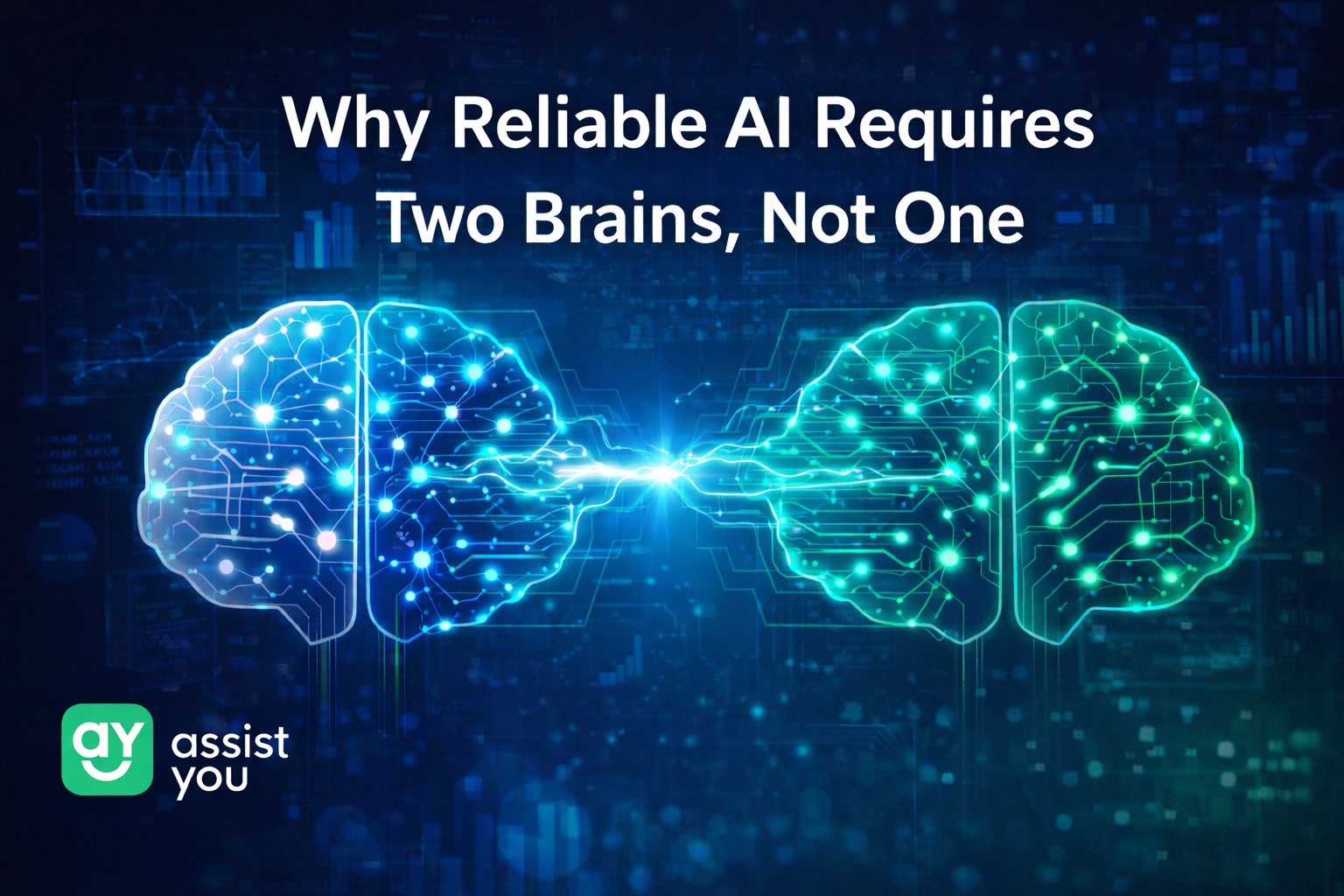
BLOG By Bram Van Zanten
Artificial intelligence is rapidly becoming the backbone of operational infrastructure. Organizations increasingly rely on AI systems to analyze customer conversations, surface insights, and drive decision-making across service teams.
But with this rapid adoption comes a critical question: how reliable are the insights these systems actually produce?
Today, many AI analytics platforms rely on a single model to do it all. The exact same system interprets conversations, extracts themes, quantifies data, and generates the dashboards that run the business. On paper, one intelligent system handling everything automatically sounds like the ideal, efficient solution.
In reality, this approach mixes two fundamentally different challenges: understanding language and measuring patterns. Forcing a single analytical process to do both introduces subtle, hard-to-detect inaccuracies over time.
Simply put: extracting meaning from a conversation is not the same problem as measuring it accurately.
The Difference Between Language Fluency and Hard Data
AI systems are remarkably good at interpreting language. They can summarize discussions, pinpoint recurring themes, detect customer intent, and highlight friction points across massive volumes of interactions. This makes AI an incredibly powerful tool for qualitative insight.
However, understanding what customers are talking about is fundamentally different from measuring patterns across thousands of interactions.
Reliable measurement requires:
Consistent, deterministic counting
Accurate data aggregation
Statistical stability over time
Organizations depend on these hard metrics to track operational trends and make informed decisions. Fluency in text interpretation does not automatically translate into mathematical precision. When you ask one model to handle both, the boundary between interpretation and hard facts blurs.
The AssistYou Architectural Approach
When we built AssistYou AI Analytics, we intentionally tackled this flaw. Instead of relying on a "one-size-fits-all" model to simultaneously interpret and measure, we designed our system around two separate, parallel architectures.
Both systems analyze the exact same granular conversation data, but they process it through completely different lenses.
1. The Qualitative Brain (Understanding Context)
This layer focuses purely on meaning and conversational dynamics. It identifies patterns in how customers and agents interact, surfacing insights like:
Recurring themes and customer intent.
Friction points and process bottlenecks.
Sentiment signals and emotional context.
It reveals the core of the interaction: why processes break down, where misunderstandings occur, and how escalation patterns form.
2. The Quantitative Brain (Measuring Reality)
Rather than interpreting meaning, this pipeline uses a highly structured approach to produce watertight metrics. This includes:
Deterministic event counting.
Structured tagging of conversation events.
Frequency and trend analysis over time.
While the qualitative brain explains what is happening, the quantitative brain proves how often it happens and whether the trend is growing or shrinking.
Why Running in Parallel is Crucial
Through this dual-architecture approach, interpretation and measurement complement each other instead of competing. One provides the context; the other guarantees the mathematical consistency.
Without this strict separation, AI analytics systems easily produce insights that sound highly plausible but are practically impossible to validate. By separating the two, organizations gain insights that are both easy to understand and 100% operationally dependable.
When AI Becomes Infrastructure
The conversation around AI still heavily focuses on what a model can do. But as AI becomes embedded in core enterprise operations, the benchmark shifts. Organizations no longer just ask if a model is capable; they ask if they can blindly trust its output.
When your business relies on AI to understand its operations, reliability becomes the only benchmark that matters. And achieving true reliability means recognizing a simple architectural truth:
One intelligent system is simply not enough.