
Address Validation for AI Voice Agents
Published 13 June 2025
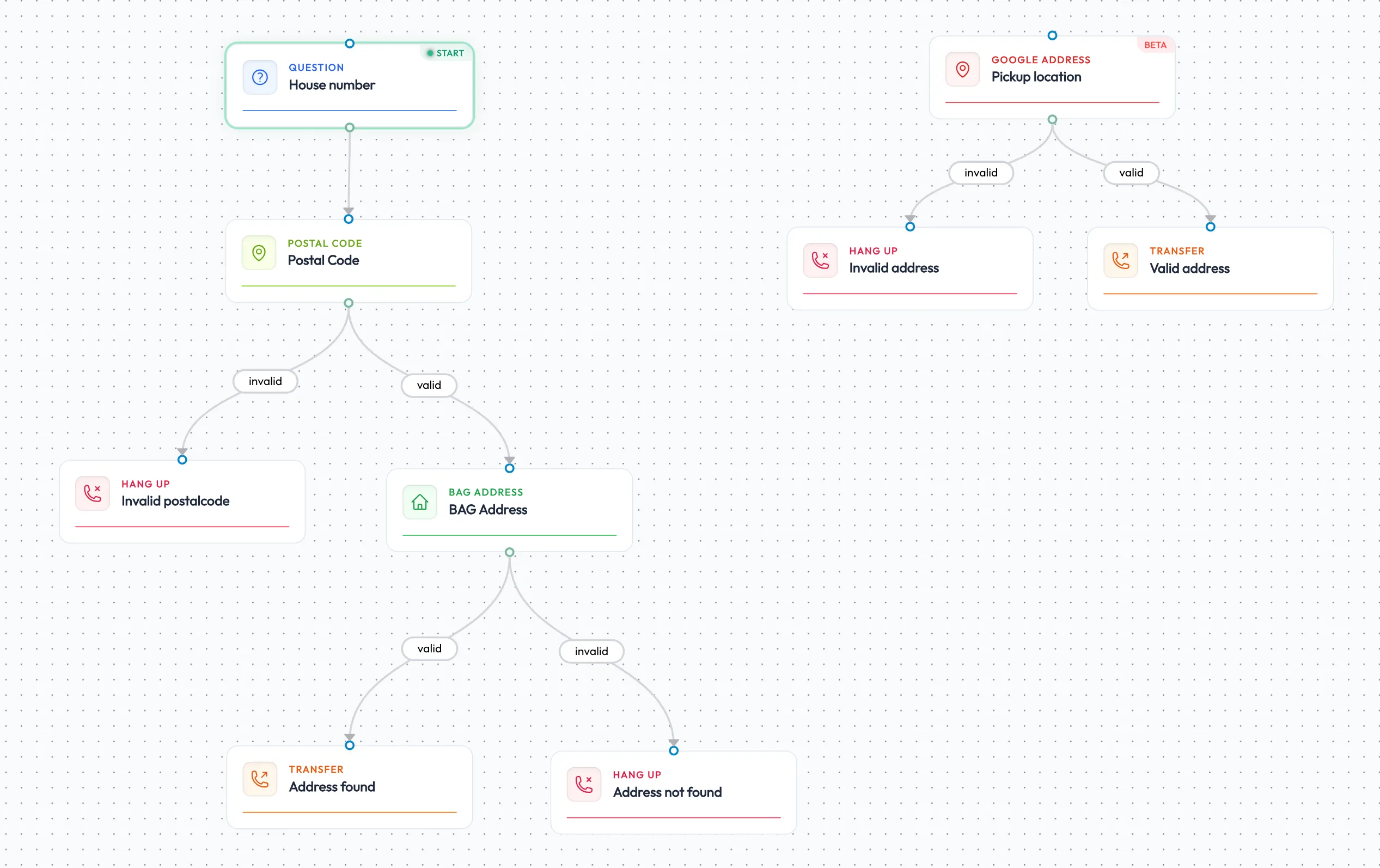
Capturing location data accurately during a live voice call is one of the most deceptive challenges in conversational design. Human speech is unpredictable, and geography itself is highly redundant. In the Netherlands alone, almost every single municipality has a Kerkstraat (Church Street) or a Stationsstraat. If a caller just says a street name without clear context, an AI Voice Agent quickly finds itself lost in a loop of ambiguity.
To give Flow Designer users (technical or non-technical alike) the exact right tool for their specific operational boundaries, AssistYou supports a dual-pathway approach to address validation: our native, compliance-driven BAG Node and our newly integrated, flexible Google Maps Node, which I built.
The Operational Divide: BAG vs. Google Maps
When designing a customer journey, choosing your validation strategy depends entirely on what happens after the call is completed.
The BAG Node: Preventing Silent Backend Failures
For enterprise organizations utilizing rigid CRM, ERP, or billing databases, data purity is everything. Many customer backend APIs are programmed to only accept records that perfectly match the official Dutch municipal registry (Basisregistratie Adressen en Gebouwen).
If an AI Voice Agent is too lenient, it introduces a massive risk to the overall user experience.
The Broken Customer Experience Loop
A customer calls to change their moving address. They say a variation of their new address that sounds plausible, and the AI Voice Agent accepts it and ends the call. The customer hangs up feeling satisfied.
However, hours later, when the data pipeline tries to push that address into the company’s core ERP system, the API rejects it because it isn’t a certified BAG entry. The update silently fails. The customer thinks their address was changed, but it wasn’t, ultimately forcing the organization to manually track down the customer and call them back to resolve the error.
The BAG node prevents this friction entirely by forcing the AI Voice Agent to validate the house number, street, and city against the legal municipal registry before the call turn ever closes.
The Google Maps Node: Conversational Adaptability and Disambiguation
While the BAG node enforces strict structural truth, the Google Maps integration is built to handle the way humans naturally speak. Callers frequently omit postal codes or substitute formal addresses for landmarks, such as requesting a pickup from “the cinema in the city center of Breda” or reporting a vehicle issue near “the Albert Heijn in Utrecht.”
The architecture I built uses global geospatial APIs to translate these conversational points of interest (POIs) into structured data. Crucially, it handles redundancy through intelligent multi-choice suggestion loops. If a caller names a venue or a street that has multiple valid matches across a city, the node doesn’t guess or crash. It dynamically builds a clarification turn, presenting both options to the caller: “I found two cinemas near the center of Breda. Did you mean the one on Central Street or Main Avenue?” This ensures the AI Voice Agent captures the exact destination intended.
Looking Ahead: The “Best of Both Worlds” Hybrid Concept
Because both nodes are natively available within the self-service AssistYou Flow Designer, a compelling architectural question emerges for advanced workflows: Why choose just one?
A highly effective strategy to optimize both front-end customer experience and back-end data purity is to combine both nodes sequentially within the same flow path. This setup processes data through a clean, multi-stage pipeline:
- Conversational Input: The caller speaks casually, using a landmark, business name, or conversational phrase.
- The Google Maps Node: Catches the messy phrasing and successfully resolves the landmark into a clean, structured address format.
- The BAG Validation Node: Instantly intercepts that resolved address and cross-checks it against the official municipal registry to verify its legal status.
- Customer API Delivery: Pushes the finalized, dual-verified data straight to your backend CRM with zero validation errors.
This hybrid design gives organizations the absolute best of both worlds: complete conversational freedom for the caller on the phone, and flawless, error-free automated data processing on the backend.
Drag-and-Drop Simplification
By packaging complex API calls, database cross-referencing, and multi-turn exception handling into clean, visual flow components, AssistYou ensures that any user can design ironclad location workflows without writing code.
That was the goal behind the Google Maps integration: giving our users the toolkit to build resilient, self-correcting AI Voice Agents.
Share Your Thoughts
We recently shared an overview of this product release on social media, which is also where the team welcomed me to engineering. Check out our accompanying LinkedIn post to join the discussion and share your thoughts on this update!
← Back to blog